Magora › Projects › Lead marketplace
Marketplace & lead generation · Case studyDiscovery & product build2026

Lead marketplace.

A UK start-up wanted to sell home-improvement leads that are captured face to face, not scraped from a web form. Magora turned the idea into two products — a tablet app that sales staff use with the customer, and an operator console that matches, delivers and invoices every lead — so the founders could put the model in front of real users early.

Client
UK start-up (name withheld)
Industry
Home-improvement lead marketplace
Stage
Discovery · tablet app · operator console
Surfaces
Tablet capture app · operator console
Year
2026
Services
Discovery · UX · Development
Delivery
Magora London
Domain
Marketplace · Lead generation
Engagement
Discovery sprint + MVP scope
Devices
Tablet · Desktop

The client is a UK start-up building a lead marketplace for home-improvement trades: kitchens and bathrooms, windows and doors, solar and battery storage, driveways and landscaping. Instead of buying clicks, its sales staff talk to homeowners in shopping centres, record what they actually need and pass the enquiry to a small number of vetted local companies.

Three things had to be true for the model to work, and none of them could be proven on paper:

  • Capture has to be fast. A salesperson has a few minutes with a customer standing in a busy mall. Every extra question costs completions.
  • The questions differ by trade. A solar installer needs roof age and electricity spend; a kitchen fitter needs the room and the budget. Hard-coding each questionnaire would make every new trade a development job.
  • Companies pay per lead, so matching must be explainable. When a company asks why it did — or didn't — receive a lead, the operator needs an answer better than "the algorithm decided".

The founders came to us before building anything. They needed something investors, sales staff and trade partners could use — and a clear view of where the real product risk sat. That is exactly what our discovery phase is for.
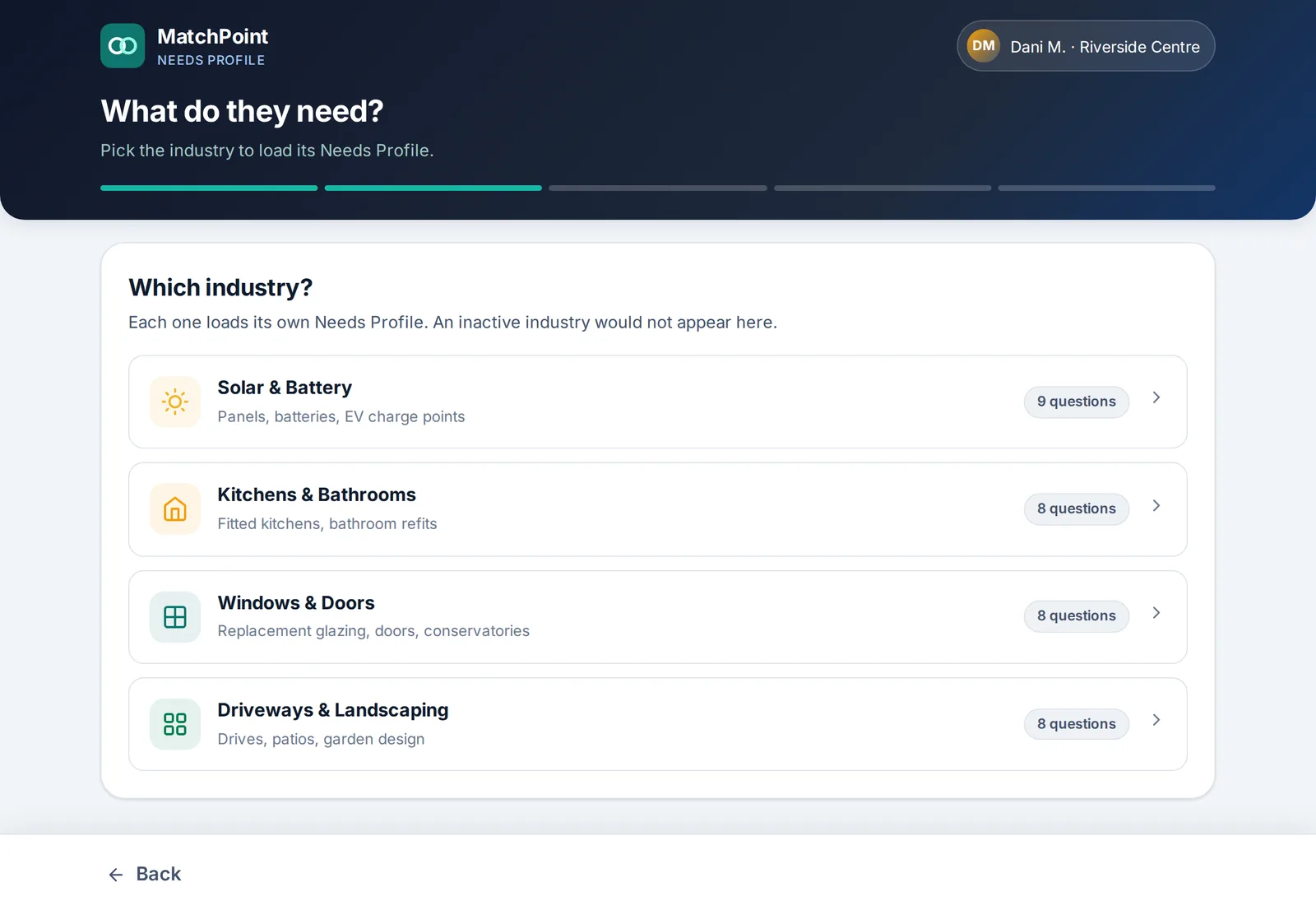
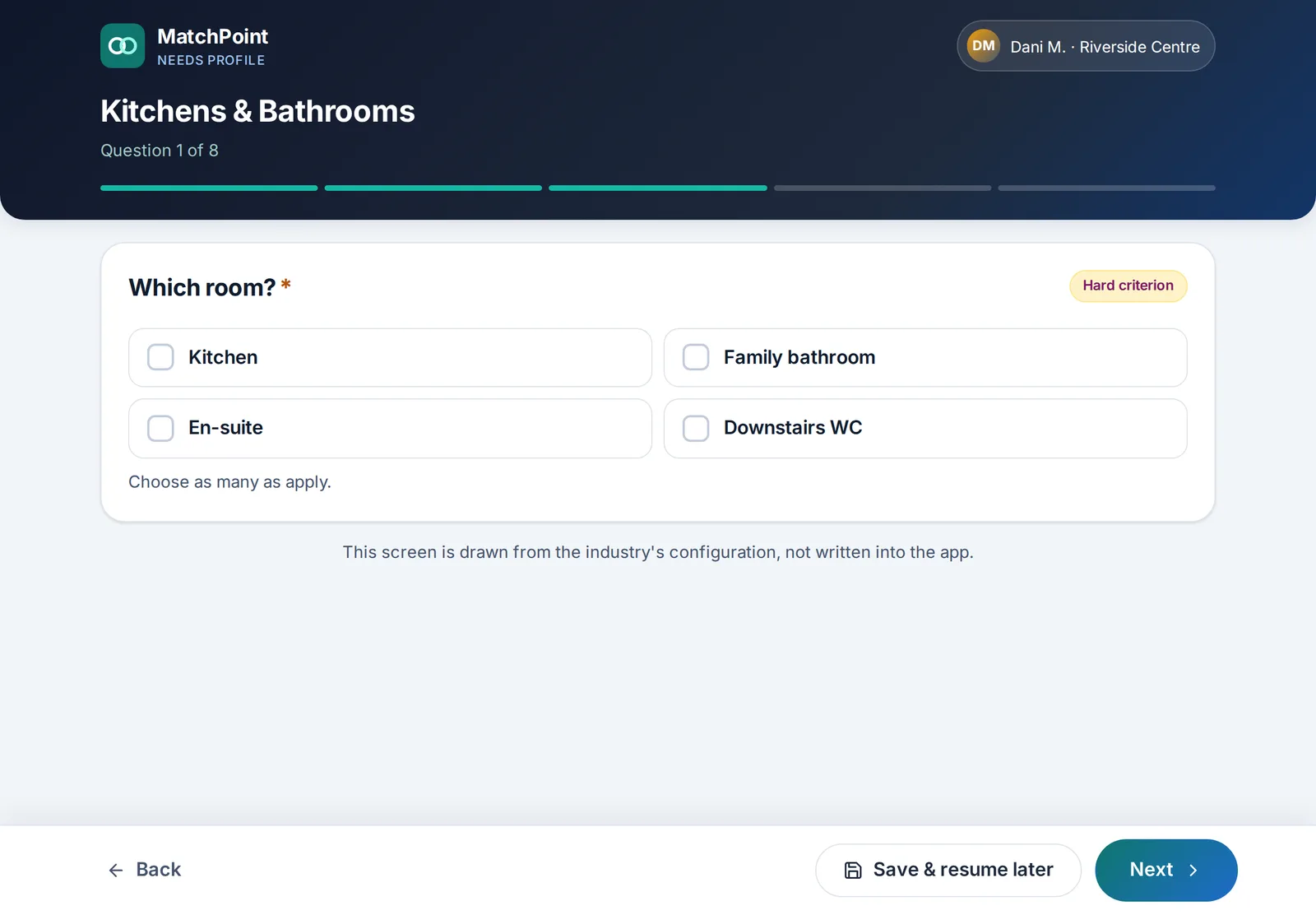
We started from the riskiest assumption rather than the prettiest screen. In discovery we mapped the whole journey — capture, consent, matching, customer choice, delivery, invoicing — and turned the questionnaire into data, not code: a Needs Profile per industry, built from a small set of answer types (six types, from single and multiple choice to ranges and free text) and flagged either as a hard criterion (a company that can't meet it is excluded) or a ranking signal (it only changes the order).

Then we built two applications that run the real logic, so every screen responds to what you enter:

  • A tablet app for sales staff and customers — the screen the business converts on.
  • An operator and company console — where leads are matched, delivered, flagged and billed.

We also added deliberate "edge-case" scenarios — no suitable company, or no signal in the mall — so the team could see on screen what a customer experiences when things don't go to plan, and decide how the real product should behave.

Tablet app: the salesperson picks the customer's project type

Tablet capture app (salesperson + customer)

  • Configurable Needs Profile. Each trade's questions are rendered from its configuration — adding a trade or a question is an operator task, not a release.
  • Consent first. The customer's details and GDPR consent are recorded, time-stamped, before any answers are shared.
  • Save and resume. A conversation interrupted in a busy centre can be picked up later without starting again.
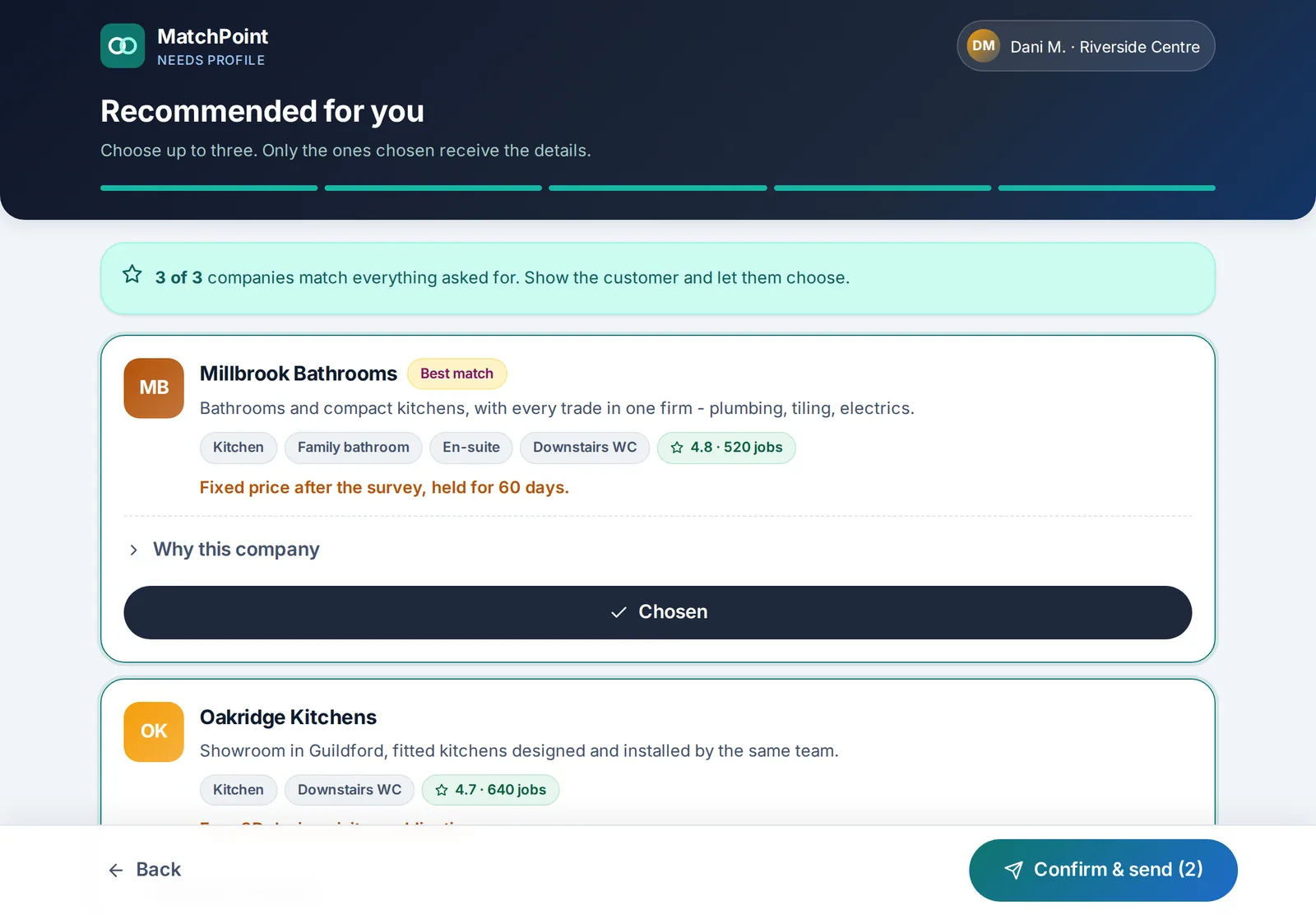
  • Instant, explainable matching. Companies are filtered on hard criteria — services offered, property type, ownership, minimum project value, appointment type, postcode coverage, weekly lead cap, paused or active — then ranked. Each recommendation has a "Why this company" panel.
  • The customer chooses up to three. Only the companies the customer picks receive the enquiry, so each enquiry is shared with a handful of firms, not sold to everyone.
Needs Profile question rendered from the industry configuration
Recommended companies with best match and why-this-company explanation

Operator and company console (desktop)

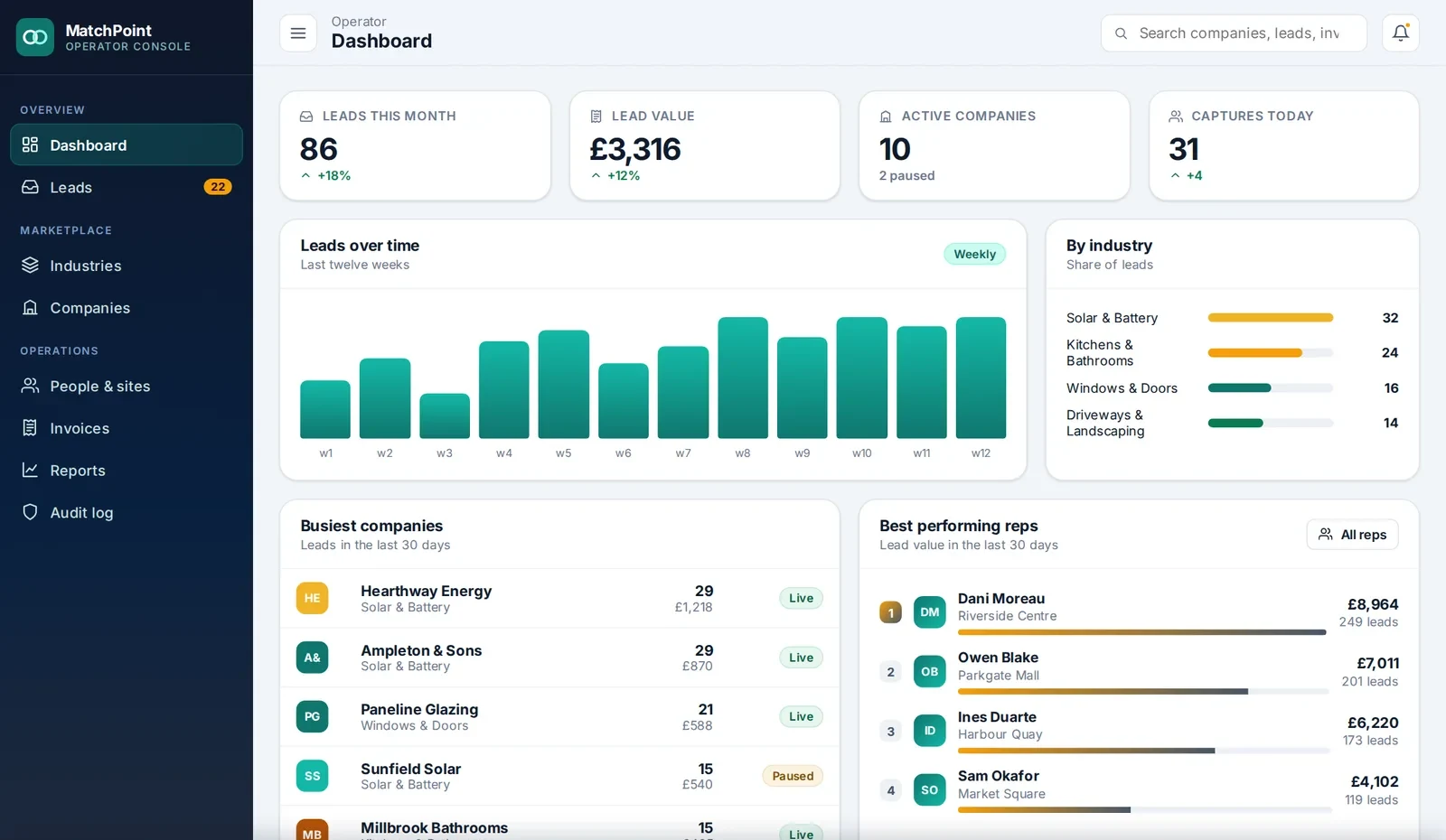
  • Dashboard — leads, lead value, active companies and daily captures, with the busiest companies and best-performing sales staff by site.
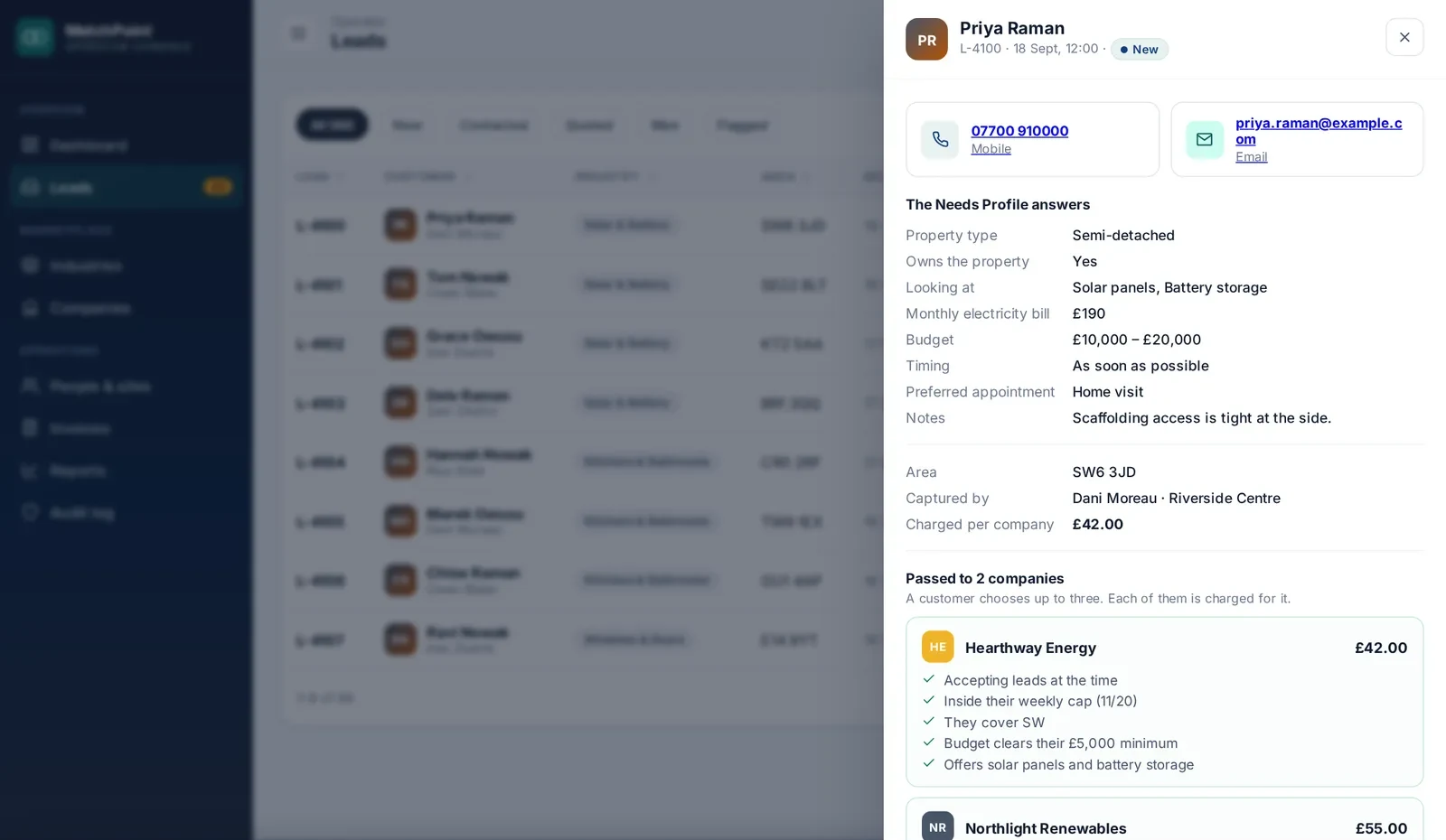
  • Lead detail — every answer, who captured it and where, and exactly which companies received it and why: each passed check is listed, and so is each reason a company was left out.
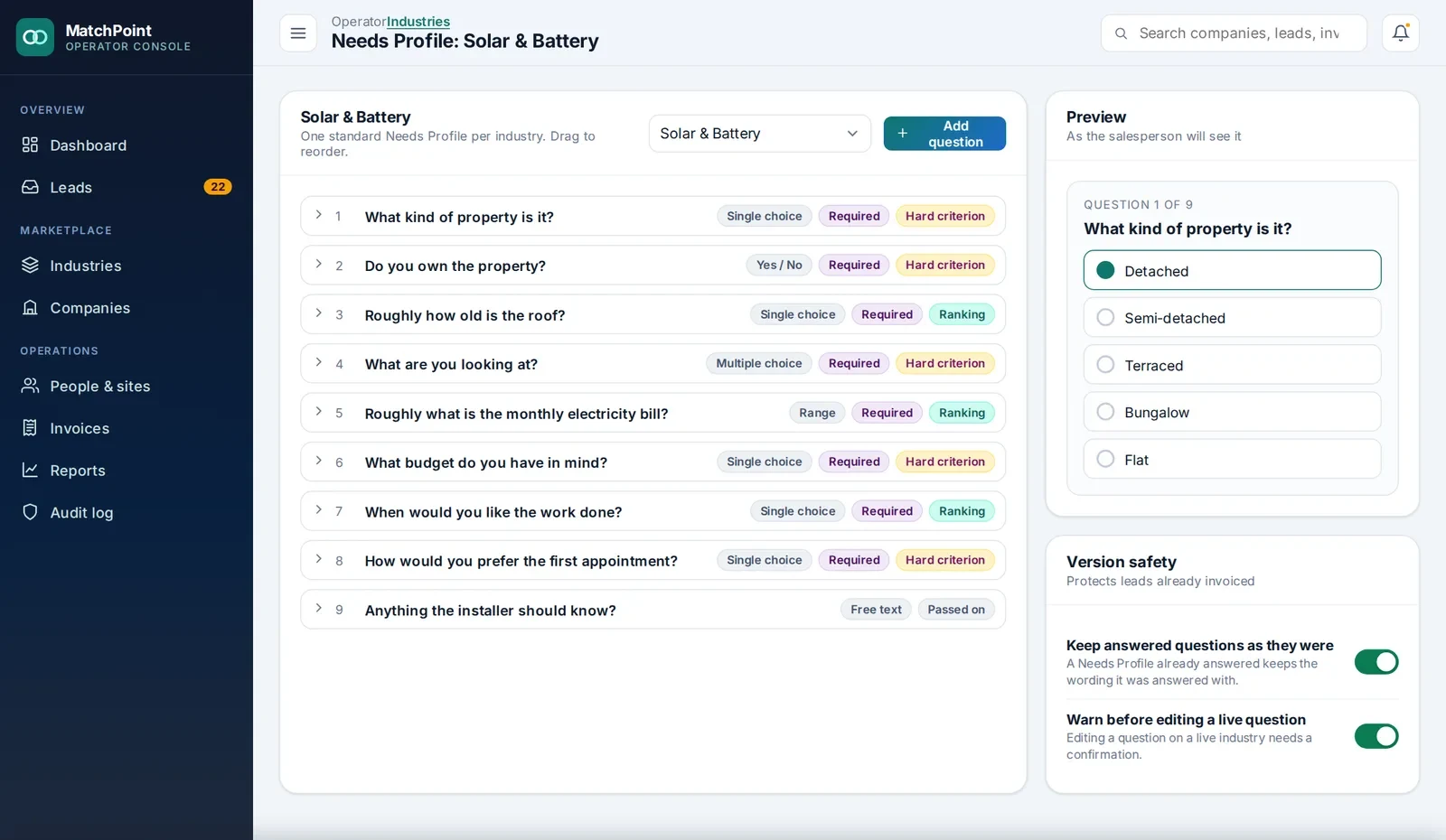
  • Needs Profile builder — add, reorder and mark questions as hard criteria or ranking signals, with a live preview of what the salesperson will see and "version safety" so leads already invoiced keep the wording they were answered with.
  • Companies, people and sites — onboarding, weekly caps, pause switches, coverage areas and the sales team per shopping centre.
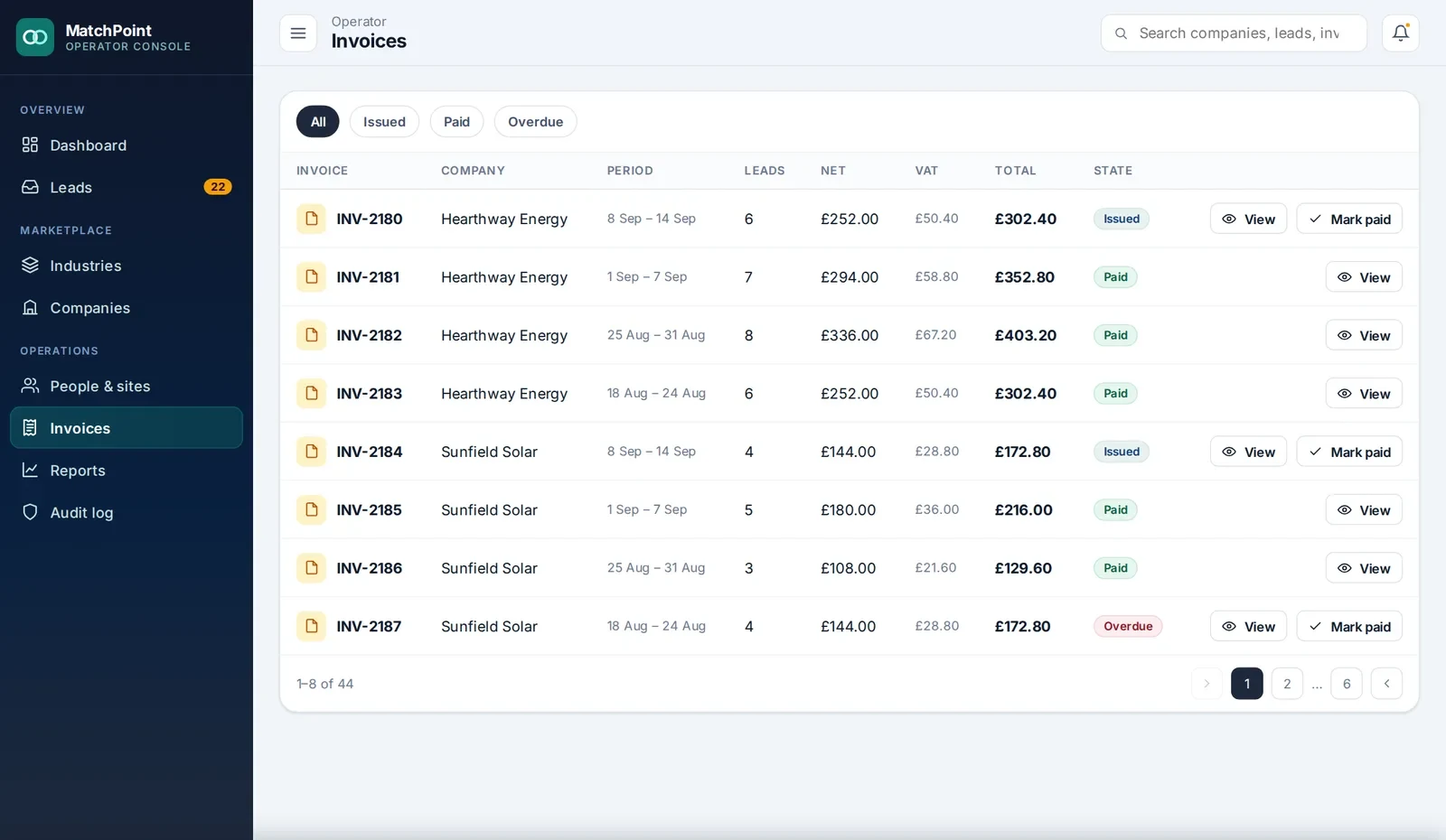
  • Invoices — weekly per-lead billing for each company, generated from delivered leads, with flagged leads held back for review.
  • Company view — a role switch shows what a trade partner sees: its own leads, a pause switch and an editable profile.
Operator dashboard with leads, lead value and top sales staff
Lead detail showing answers and why each company received the lead
Needs Profile builder with hard criteria, ranking signals and live preview

What the client came away with:

  • A tablet app and an operator console that run the real matching rules, ready to put in front of sales staff, trade partners and investors.
  • A ranked list of product risks — from offline capture in a flow whose payoff is online, to who can edit a live questionnaire safely — each argued on screen rather than in a document.
  • A scoped, phased build plan for an MVP, with what belongs in the first release and what can wait.

If you are planning a marketplace, a lead-generation platform or a tablet app used face to face, this is the kind of work we do — see our MVP development and SaaS development services, or talk to the team behind this project.

Weekly per-lead invoices for each company

The project in numbers.

2
Interfaces: tablet app + operator console
4
Trades configured at launch of the model
6
Answer types in the Needs Profile
3
Companies max per lead
Weekly
Per-lead invoicing
1
Rules engine shared by tablet and console
£19.5k
Approx. MVP budget · ≈ 12 weeks
£29k
Approx. full programme · ≈ 18 weeks

Budget estimated from our discovery and development breakdown; indicative, excluding VAT. Every project is priced after a discovery sprint.

Tech stack.

HTML5CSSVanilla JavaScriptConfig-driven renderingRules-based matching engineResponsive tablet UI
Building a marketplace?

Planning something similar?

30 minutes with the team behind this project. We'll go through both apps, show how the matching and invoicing work, and tell you what we'd build first for your model.

Talk to the team →
— Cookies

We use cookies to measure traffic and make our marketing more relevant. Necessary cookies stay on. See our Privacy and Cookie Notice.

Free 30-min consult Free consult